Showing posts with label Ten Commandments. Show all posts

Wednesday, December 19, 2007

Looking Back - Theonomy

"Dr. Van Til taught us that "There is no alternative but that of theonomy and autonomy" (Christian-Theistic Ethics, p. 134). Every ethical decision assumes some final authority or standard, and that will either be self-law ("autonomy") or God's law ("theonomy"). While unbelievers consider themselves the ultimate authority in determining moral right or wrong, believers acknowledge that God alone has that position and prerogative. The position which has come to be labeled "theonomy" today thus holds that the word of the Lord is the sole, supreme, and unchallengeable standard for the actions and attitudes of all men in all areas of life. Our obligation to keep God's commands cannot be judged by any extrascriptural standard, such as whether its specific requirements (when properly interpreted) are congenial to past traditions or modern feelings and practices."

~ Greg Bahnsen

Thursday, October 18, 2007

Looking Back - Stony Ground Hearers

"There are so many stony ground hearers who receive the Word with joy that I have determined to suspend my judgment till I know the tree by its fruits ...Do you think any farmer would have a crop of corn next year unless he plowed now? You may as well expect a crop of corn on unplowed ground as a crop of grace until the soul is convinced of its being undone without a Savior. That is the reason we have so many mushroom converts, so many persons that are always happy! happy! happy! and never were miserable. Why? Because their stony ground is not plowed up; they have not got a conviction of the law."

~ George Whitefield

Thursday, July 26, 2007

The Sabbath as a Feast

Too many people today see the Sabbath (or Lord's Day) as a fast instead of a feast. Lev 23:3 makes it clear that is is intended to be a feast. "The Lord spoke to Moses, saying, “Speak to the people of Israel and say to them, These are the appointed feasts of the Lord that you shall proclaim as holy convocations; they are my appointed feasts. Six days shall work be done, but on the seventh day is a Sabbath of solemn rest, a holy convocation. You shall do no work. It is a Sabbath to the Lord in all your dwelling places."

We have completely lost the art of feasting and biblical celebration

  • We’ve become to pious to party
  • We have stripped devotion of any kind of celebration
  • We have secularized festivity
Maybe just to shake up our fragile piety and our fanatical busyness God commands us to do something like this in the context of the Sabbath:
  • "...then you shall turn it into money and bind up the money in your hand and go to the place that the Lord your God chooses and spend the money for whatever you desire—oxen or sheep or wine or strong drink, whatever your appetite craves. And you shall eat there before the Lord your God and rejoice, you and your household. And you shall not neglect the Levite who is within your towns, for he has no portion or inheritance with you." (Duet 14:25-27)
Douglas Jones and Douglas Wilson, in their book “Angels in the Architecture” sarcastically commented on this verse: “Such unthriftiness. Such waste. Such gluttony. Such winebibbing. Such is a command of our holy God.”

They also wrote this:
  • Celebration is worshiping God with our bodies, with the material creation He has set up around us. Celebrating – whether in feasts, ceremonies, holidays, formal worship, or lovemaking –are all part of obeying God’s command to “love the Lord thy God with all thine heart, with all thy soul, and with all thy strength” (Dt 6:5; Mk 12:30) We are to show our love for God not just with one portion of our being (the spiritual aspect); we are to love God with our whole body, heart and strength and legs and lips.
  • Complaint is the flag of ingratitude, and it waives above the center of unbelieving hearts –“when they knew God, the glorified him not as God, neither were thankful” (Rom 1:21). Yet by grace, God’s redemption in creation ought to keep us in a perpetual state of thanks which bursts out in celebration at every opportunity. Again, we are celebrating God’s dominion
We need to restore the Lord's Day to the great celebration feast that it was intended to be. We have been given the victory in Christ. We shall inherit the earth. Christ is on the throne and He is in the process of placing all enemies under His feet. So lift up your glasses of Cabernet Sauvignon with me and let's toast to Christ the King and His Kingdom!

As R.J. Rushdoony says, "To deny the Sabbath, and that the Sabbath was made for man to rest and enjoy his lordship in Christ, is to remove the future from man’s life. The Sabbath truly observed speaks of victories gained in the world to be conquered." He also said this, "Without that association of the Sabbath with work, salvation, and victory, it becomes a day of boredom and another step in a life without a significant future.”

Monday, April 23, 2007

God in our image...

When Moses was up on the mountain getting the Ten Commandments Aaron was gathering the gold jewelery from the people of Israel in order to make a golden calf. "And he received the gold from their hand and fashioned it with a graving tool and made a golden calf. And they said, “These are your gods, O Israel, who brought you up out of the land of Egypt!” When Aaron saw this, he built an altar before it. And Aaron made proclamation and said, “Tomorrow shall be a feast to the Lord.” (Ex 32:4-5) What's interesting is that when he said "Tomorrow shall be a feast to the Lord" the word Lord in the Hebrew is Yahweh. He was calling the golden calf Yahweh.

God makes us in His image and then we try and make God into our image. Man, in his rebellion, wants to make God into his own image. God form's us and then we, in idolatrous worship, form Him. Idolatry is so dangerous because once you create a god in your mind that you like and that you’re comfortable with, you will also create a moral standard to go along with him. What we do is create a god that likes the things we like and permits the things we want to do. A golden calf doesn't say, "Thou shall not commit adultery" or "Thou shall not bear false witness." So we create a god in our image and then create a moral code that we like.

One way to tell if someone is doing this form of idolatry is this... they will begin their sentence with “To me…” They will say stuff like, “To me God is like __________” (Fill in the blank with whatever you want.) Watch the following video clip from Way Of The Master ministry for an example of this:

Saturday, March 31, 2007

Christ is the Substance of the Law

I got this from John M. Frame, Christ was not only perfectly obedient to God's Law, He was also the substance of the Law...

"Here I wish to say that Jesus is not only a perfect law-keeper (according to his humanity), but that according to his deity he is the one we honor and worship when we keep the law:

1. The first commandment teaches us to worship Jesus as the one and only Lord, Savior, and mediator (Acts 4:12; 1 Tim. 2:5).

2. In the second commandment, Jesus is the one perfect image of God (Col. 1:15; Heb. 1:3). Our devotion to him precludes worship of any other image.

3. In the third commandment, Jesus is the name of God, that name to which every knee shall bow (Phil. 2:10-11; cf. Is. 45:23).

4. In the fourth commandment, Jesus is our Sabbath rest. In his presence, we cease our daily duties and hear his voice (Luke 10:38-42).

5. In the fifth commandment, we honor Jesus who has brought us as his “sons” (Heb. 2:10) to glory.

6. In the sixth commandment, we honor him as the life (John 10:10; 14:6; Gal. 2:20; Col. 3:4), Lord of life (Acts 3:15), the one who gave his life that we might live (Mk. 10:45).

7. In the seventh commandment, we honor him as our bridegroom who gave himself to cleanse us, to make us his pure, spotless bride (Eph. 5:22-33). We love him as no other.

8. In the eighth commandment, we honor Jesus as our inheritance (Eph. 1:11) and as the one who provides all the needs for his people in this world and beyond.

9. In the ninth commandment, we honor him as God’s truth (John 1:17; 14:6), in whom all the promises of God are Yea and Amen (2 Cor. 1:20).

10. In the tenth commandment, we honor him as our complete sufficiency (2 Cor. 3:5; 12:9) to meet both our external needs and the renewed desires of our hearts."

John M. Frame

Friday, March 30, 2007

The Speck In Your Eye

One of the most well known verses, even among non-Christians, is "judge not." In an age of Postmodernism, the only absolute moral left is toleration (or "judge not"). "It's OK if you believe what you want to believe" they say, "but don't judge me for what I believe." Was Jesus really telling us to never judge anyone? Was He saying that His Law must not be used as a standard of judgment anymore? The following was written by Gary North and it sheds some light on this topic...

"Jesus was not denying the legitimacy of biblical law. On the contrary, He was affirming biblical law. We love God first; God commands us to keep His word; therefore, we must enforce the law on ourselves. We start with ourselves because we have more knowledge of ourselves and more responsibility over ourselves. This is the meaning of progressive sanctification. Jesus was not calling us to ignore biblical law; He was calling us to enforce it first on ourselves, before we enforce the same laws on others.

Judge not, that ye be not judged. For with what judgment ye judge, ye shall be judged: and with what measure ye mete, it shall be measured to you again. And why beholdest thou the mote that is in thy brother's eye, but considerest not the beam that is in thine own eye? Or how wilt thou say to thy brother, Let me pull out the mote out of thine eye; and, behold, a beam is in thine own eye? Thou hypocrite, first cast out the beam out of thine own eye; and then shalt thou see clearly to cast out the mote out of thy brother's eye. (Matt. 7:1-5)

Notice what he did not say. He did not say that it is all right to go through life with motes (small chips) in our eye. The eye is the most sensitive organ in the body. A mote in an eye could blind it, or seriously interfere with our vision. Jesus did not condone sin in any form. Sin is a horror; it jeopardizes our very existence. It should not be allowed to remain in your eye, and we are required by God to do what we can to help remove chips from our neighbors' eyes. We are to use biblical law to assist them. What Jesus was saying is that we need to be constantly on the lookout for motes in other people's eyes, so that we can help them remove them. But to accomplish this, we must first get rid of the beams in our own eyes. We must be able to go to the other person and tell him: "Look, I used to have a really bad beam in my eye, and it blinded me. But through the grace of God, I was able to remove it. I see that you're suffering from the same thing. Let me show you how God's word speaks to your minor problem, just as it spoke to my major one." In other words, "I've been there. I know what it is. It leads to blindness and agony"....

The context of the "Sermon on the Mount" shows clearly that the "judge not" passage is a call to dominion. It instructs us to begin with ourselves, so that we can then work to extend the principles and enforcement of God's principles to areas of life over which we have lawful authority."

Gary North, The Sinai Strategy: Economics and the Ten Commandments (Tyler, TX: Institute for Christian Economics, 1986), pp. 310-312 .

Friday, March 16, 2007

Are you keeping the Ten Commandments?

Have you put other gods before God?

  • Is He the #1 priority in every area, both private and public, of your life?
  • Do you keep Him first in your life?
  • Does your mind automatically drift toward something or someone else besides God during the day?
  • Is He Lord of all in your life?
  • Do you fear God and God alone?
  • Is your mouth monotheistic but your actions polytheistic?
  • Do you put yourself before God?
  • Do you put power or position or possessions before God?
  • Are you keeping the Ten Commandments?

Have you taken the Lord’s name in vain?

  • Do you use swearing or cursing in vain or apart from God?
  • Is your speech or living marked by profanity?
  • Have you used the curse that is worthy of death?
  • Is your speech, in reference to God, free of blasphemy?
  • Do you speak about God flippantly or disrespectfully?
  • Do you call yourself by His name (Christian) and live like a heathen?
  • Does your car have a fish on the bumper and a middle finger out the window?
  • Does your t-shirt say “Jesus” and your life say “Self”?
  • Does your worship say Allelu-Ya and your life say Allelu-me?
  • Are you keeping the Ten Commandments?

Do you commit murder?

  • Are you violent toward others in inappropriate ways?
  • Have you ever hated a friend or relative?
  • Have you ever called anyone you know an idiot?
  • Are you kind and considerate and accepting and understanding?
  • Do you have anger issues that control you sometimes?
  • Are you involved in self-destructive behavior?
  • Have you “murdered” someone’s reputation through gossip?
  • Does your work ethic violate the law against murder?
  • Do you promote and defend life in your sphere of influence?
  • Is there blood on your hands because of your silence or apathy?
  • Are you keeping the Ten Commandments?

Do you commit adultery?

  • Have you ever looked at someone, you weren’t married to, with lust?
  • Has your mind and thoughts always been 100% clean?
  • Have you ever looked at a magazine or a poster too long?
  • Men, have you ever kept looking at an immodest woman?
  • Ladies, have you ever dressed so as to get attention of men?
  • Have you ever watched a movie or TV show that you shouldn’t?
  • Have you ever lusted in the reading of a book?
  • Have you ever been on websites that you shouldn’t?
  • Are you faithful to your roles as a man or as a woman?
  • Is your marriage honorable in the sight of God?
  • Is your heart given to something or someone other than your mate?
  • Do you think on things are honorable and pure?
  • Are you keeping the Ten Commandments?
And these are just 4 out of 10

Monday, November 20, 2006

The Forgotten Commandments


The Ten Commandments are alive and well in the earth today. They are not among the long list of dead and forgotten artifacts of the past. They are just as powerful and pertinent today as they were in the days of Moses. The Ten Commandments are not just a prop in some insignificant Sunday school class. They are the unwavering force behind all the triumphs and tragedies of world history. The centerpiece of all civilized and ethically stable cultures throughout history has been the old two tablets of stone.

These tested and tried Commandments are not some set of totalitarian and tyrannical laws that men should struggle to be set free from. Many see the Ten Commandments as the opposite of grace. The Bible makes it clear that they were given out of grace. In fact, the very first thing God said before He gave the first commandment is “I am the Lord your God, who brought you out of the land of Egypt, out of the house of slavery.”[1] In other words, He is contrasting His Law with slavery. He freed them and gave them the great laws of liberty. The Ten Commandments were not given to slaves so as to imprison them but to free men so as to guide them.

About 1,400 years after being given to Moses, the Ten Commandments were summed up in the New Testament when Jesus was confronted by the religious "experts" of the day: “Teacher, which is the great commandment in the Law?” And he said to him, “You shall love the Lord your God with all your heart and with all your soul and with all your mind. This is the great and first commandment. And a second is like it: You shall love your neighbor as yourself. On these two commandments depend all the Law and the Prophets.”[2] Jesus was just revealing that the first four commandments given to the children of Israel are summarized in the statement: “Love the Lord your God with all your heart and with all your soul and with all your mind.” The last six commandments are summarized in the statement: “Love your neighbor as yourself.”

One terrifying yet trendy misconception about the Ten Commandments today is that they were only relevant to and required in the Old Testament age. When we look into the New Testament, though, we easily find the Ten Commandments still full of life and authority. The apostle Paul makes this clear when he warns, “Do not be deceived: neither the sexually immoral, nor idolaters, nor adulterers, nor men who practice homosexuality, nor thieves, nor the greedy, nor drunkards, nor revilers, nor swindlers will inherit the kingdom of God.” [3] The Ten Commandments are just as relevant in the New Testament as in the Old.

In fact, if it weren’t for the Law of God, we “New Testament” Christians would have no way of identifying what exactly sin is - “…if it had not been for the law, I would not have known sin. I would not have known what it is to covet if the law had not said, “You shall not covet.”[4] Without the Law we are completely ignorant about sin, for “through the law comes knowledge of sin.”[5] If we are not able to identify sin we will not be able to recognize our need to have our sins forgiven. If we do not recognize our need to have our sins forgiven we will not see our need for a Saviour. The law, indeed, is our “schoolmaster to bring us unto Christ, that we might be justified by faith.”[6]

In our postmodern world, where nearly all of the population (including Christians) cannot even recite the Ten Commandments from memory, we desperately need to be reminded of what they are. Recent surveys have shown us that in the typical church congregation less than 1% of the people can list on a sheet of paper the Ten Commandments, in any order or form. How can we ever expect our country and its leaders to adhere to a moral code that most Christians have forgotten? This is why we must follow the advice in Deuteronomy 6:7-9 and teach the Law diligently to our children, and talk of them when we sit in our house, and when we walk by the way, and when we lie down, and when we rise up. We need to write them on the doorposts of our house and on our gates.

Displaying the Ten Commandments is not the answer to all our problems but it is a giant first step in the right direction. Many revivals in the Bible were a direct result of God’s people rediscovering God’s Law. We must all do our part in whatever way we can to remind our nation about her ethical history and her moral foundation. It is sad that non-Christians have removed the Ten Commandments from the schools and the courthouses but the real tragedy is that Christians have unknowingly removed them from the walls and from the minds of their own homes and churches. The Ten Commandments are not burdensome and oppressive. They form the launch pad of liberty and the springboard of morality. It is just as true today as it has ever been that “…Happy are the people whose God is the Lord![7]


[1] Exodus 20:2 (ESV)

[2] Matthew 22:36-40 (ESV)

[3]1 Corinthians 6:9-10 (ESV)

[4] Romans 7:7 (ESV)

[5] Romans 3:20 (ESV)

[6]Galatians 3:24 (KJV)

[7] Psalms 144:15 (NKJV)


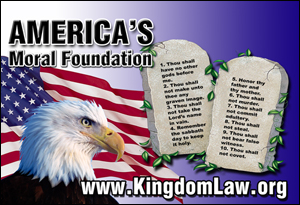
Check out KingdomLaw.org